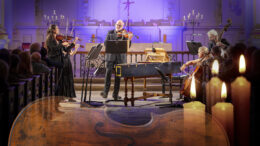
Vivaldi Four Seasons by Candlelight

Experience a magical evening of classical music by candlelight with St Martin’s Chamber Ensemble and featuring violinist Richard Milone.

This elegant programme includes Mozart’s charming Kontretanz from The London Sketchbook, Boccherini’s graceful Minuet, Fiocco’s lyrical Andante, and the timeless beauty of Pachelbel’s Canon in D. The evening culminates in a vivid performance of Vivaldi’s Four Seasons – a true celebration of Baroque brilliance.


Vivaldi Four Seasons by Candlelight

Enjoy an intimate, candlelit evening of classical music featuring Mozart’s Divertimento in B flat major and Vivaldi’s Four Seasons.

Mozart’s Divertimento showcases his mastery of light, elegant melodies and intricate harmonies, offering a graceful and uplifting listening experience. Vivaldi’s Four Seasons brings to life the changing moods of nature through vivid, expressive movements that paint a rich musical picture of spring, summer, autumn, and winter.


Rokas Valuntonis (piano)

Pianist Rokas Valuntonis returns to St Martin’s with a programme showcasing his ‘liquidity of sound’ spanning German Romanticism and French Baroque. The recital begins with Beethoven’s “Pathétique” Sonata, a work famous for its shift from intensity to the beauty of its celebrated Adagio. This is paired with Grieg’s Album Leaves, four poetic miniatures that capture the folk-inspired lyricism of Norway, and a selection of Couperin’s keyboard works.

The performance concludes with Chopin’s lyrical and virtuosic Andante Spianato and Grande Polonaise Brillante, serving as a brilliant finale to this lunchtime concert.


Vivaldi Gloria by Candlelight

A transcendent evening of sacred and celebratory works by J.S. Bach and Antonio Vivaldi.

From the serene beauty of Jesu, Joy of Man’s Desiring and the reverent Jesu, meine Freude to the resounding glory of Vivaldi’s Gloria, this programme offers a rich tapestry of Baroque brilliance and spiritual joy.


Violetta Suvini (violin) and Henry Lewis (piano)

Violinist Violetta Suvini and pianist Henry Lewis showcase three contrasting works: Ravel’s youthful Sonate Posthume, Beethoven’s maverick Sonata No. 4 in A minor, and the folkloric idiom of Janáček’s Violin Sonata.

Unpublished until 1975, decades after Ravel’s death, this charming early work comprises only a single movement, and is thought to be a sketch written for Fauré’s composition class as Ravel’s first exploration of sonata form. It conveys a light, youthful feeling through its explorative melodies, and demonstrates Ravel’s early skill in constructing luminous, shifting harmonies.

Beethoven’s early sonatas are noted for involving the violin in a more equal partnership with the then-dominant fortepiano. Though the 4th Sonata is often overshadowed by the ‘Spring’ Sonata (No.5), the former marks “a notable advance in dramatic style over its predecessors” (Heeney). Described by Lockwood as “the wayward stepchild among Beethoven’s violin sonatas”, its quick changes of mood, condensation of form, strides towards unorthodox modulations, and unexpected rhythmic qualities, leave a strong impression.

“Janáček’s music is steeped in the folk music idioms and speech patterns of his Moravian homeland: he claimed “the whole life of man is in folk music”. This composer’s material follows closely the inflections, cadences and rhythms of the Czech language.” (Markow). His unique musical expression can be heard in the rhythmic and melodic fragments which are repeated and juxtaposed between the violin and piano. The second movement ‘Ballade’ was written first as a stand-alone piece, before finding its place as the lyrical heart of this sonata.
 

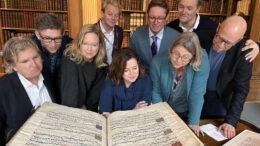
TONUS PEREGRINUS: The Eton Choirbook – Crossroads of the Renaissance

Join acclaimed vocal ensemble TONUS PEREGRINUS for a captivating journey back to early Tudor England.

This special concert brings to life the Eton Choirbook, a manuscript of breathtaking choral works written on the eve of the Reformation and one of the greatest treasures of British music.

Experience the soaring lines, luminous harmonies and spiritual intensity that defined an age of both artistic flowering and looming upheaval. TONUS PEREGRINUS – praised worldwide for its purity of tone and interpretive insight – unveils music of staggering beauty, an unforgettable journey to the heart of England’s musical golden age – where sacred art met seismic change, and every note still resounds with timeless power.


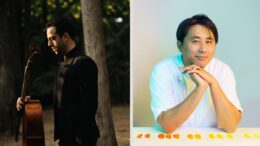
Timotheos Petrin (cello) and George Fu (piano)

Bach’s famous First Cello Suite with its beautiful and profound musical simplicity is a wonderful opener to today’s lunchtime recital, dramatically contrasted with Rachmaninov’s Cello Sonata – a deeply expressive, late-Romantic work in which cello and piano share equal, symphonic weight and dark intensity.