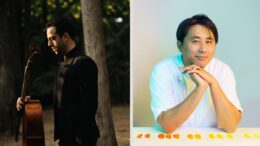
Timotheos Petrin (cello) and George Fu (piano)

Bach’s famous First Cello Suite with its beautiful and profound musical simplicity is a wonderful opener to today’s lunchtime recital, dramatically contrasted with Rachmaninov’s Cello Sonata – a deeply expressive, late-Romantic work in which cello and piano share equal, symphonic weight and dark intensity.


Sounds of India: Resonance

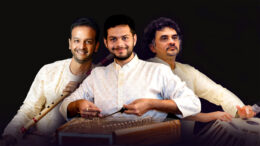
Resonance: Ode to Call of the Valley brings together three of Indian classical music’s most expressive voices in an intimate trio performance. Santoor virtuoso Ninad Daithankar and bansuri exponent Saurabh Vartak are joined by accomplished tabla artist Saleel Tambe, creating a rich and evolving musical conversation rooted in the Hindustani tradition.

Ninad Daithankar plays the santoor—a hundred-stringed trapezoid instrument from Kashmir, struck with lightweight wooden mallets. A Citi–NCPA Scholar, he has performed extensively across India, Europe, and North America. Saurabh Vartak performs on the bansuri, the bamboo flute deeply associated with Lord Krishna. Based in Pune, he regularly performs alongside the legendary Pandit Hariprasad Chaurasia and runs his own academy dedicated to preserving and passing on this lineage.

In this trio setting, melody and rhythm unfold collaboratively within a chosen raga (melodic framework) and tala (rhythmic cycle). The santoor and bansuri weave and exchange melodic phrases while the tabla anchors, accents, and propels the music forward. As the performance develops, the interplay becomes increasingly layered and dynamic, culminating in a fluid three-way dialogue. The bell-like resonance of the santoor, the warm, breathy tone of the bansuri, and the rhythmic clarity of the tabla together create a soundscape that is both meditative and exhilarating.

Sounds of India: Jesse Bannister and Jasdeep Singh

What happens when the warm, winding tones of jazz saxophone meet the ancient percussion of jori? You get something rare, an experience that is both meditative and thrillingly experimental.

This fusion is no accident. Jesse Bannister, born of mixed Indian and British heritage, has spent his career bridging musical worlds with daring intention. Trained under Pandit K. Sridhar, he has composed for the Hallé Orchestra, Royal Liverpool Philharmonic, and City of London Sinfonia, and collaborated with luminaries including Talvin Singh, Bickram Ghosh and Aruna Sairam. His project In Tune draws together Indian classical music, orchestral composition, and sound healing into a single, cohesive vision, performed across England at the London Jazz Festival, Darbar, Bridgewater Hall, and the QEH.

Anchoring the rhythm is Jasdeep Singh, a dedicated jori exponent who is on a mission to restore this ancient double-headed drum to its rightful place at the heart of Indian classical music. Long used as an accompanying instrument, Jasdeep believes the jori deserves to be heard as a lead voice, rich in texture, expressive in tone, and steeped in centuries of tradition.

Where jazz breathes and tradition pulses, something extraordinary takes shape.

Sounds of India: Chandra Chakraborty

Chandra Chakraborty is one of Britain’s foremost Indian classical vocalists, specialising in khayal—the predominant vocal form of North Indian classical music. A Gold Medallist of All India Radio and former scholar of the Sangeet Research Academy, she has performed at the Southbank Centre, the House of Commons, and for Her Majesty the Queen. She is accompanied by esraj (a bowed string instrument) and tabla.

Khayal, meaning ‘imagination’, gives the singer freedom to improvise within a chosen raga. The performance typically begins with an unmetered alaap—a slow, wordless exploration of the raga’s notes and phrases—before introducing a bandish (composition) set to a tala. The singer then develops the raga through techniques including taan (rapid melodic passages) and bol (rhythmic play with the song’s lyrics). The esraj mirrors and responds to the voice, while the tabla maintains the rhythmic cycle and engages in dialogue with the singer.


Nikita Lukinov (piano)

Discover the charm of Prokofiev’s Cinderella, the dark enchantment of Mussorgsky’s Night on a Bald Mountain, and the radiant beauty of Tchaikovsky’s Sleeping Beauty. Nikita’s hands will cast magic spells that will transport you to a place where fairytale wonder and supernatural mystery blend into something truly magical.


Rustam Khanmurzin (piano)

We regret that Matan Porat is unable to be here to give today’s lunchtime concert, because bad weather has severely disrupted flights from Berlin. We are very grateful to the talented young pianist Rustam Khanmurzin for stepping in at short notice.


Rustam Khanmurzin programme: 

Wagner-Liszt Liebestod from Tristan und Isolde

Beethoven Sonata in E major, Op 109

  1. Vivace ma non  troppo – Adagio espressivo
  2. Prestissimo
  3. Andante molto cantabile ed espressivo

Ravel La valse


Rustam Khanmurzin is a rising pianist who is gaining recognition as both a soloist and collaborative artist across Eurasia. He was previously a Junior Fellow at the Royal College of Music, and in July 2025 he was elected a Freeman of the Musicians’ Company of the City of London.

Rustam has performed at major international festivals, including the El Lied Festival Victoria de los Ángeles, MusicFest Perugia, Festival d’Auvers-sur-Oise, Rheingau Musik Festival, Oxford Song Festival, St Endellion Festival in Cornwall. He has appeared on Radio France Musique and released two CDs with the Melodiya label. As a soloist, he has worked with several orchestras, such as The Elgar Sinfonia of London, Moscow State Symphony Orchestra, Ulsan Philharmonic Orchestra in South Korea, and the Karaganda Philharmonic Orchestra in Kazakhstan.

He won 1st Prize at the Royal College of Music Concerto Competition, and also received prizes at the Paul Badura-Skoda International Piano Competition in Vienna, the CLAMO International Piano Competition in Murcia, Spain, and Asia-Pacific F. Chopin Piano Competition in Daegu, South Korea.
Londinium Consort

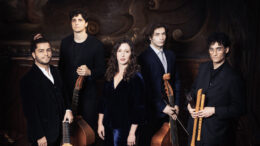
In a programme featuring music from the reign of both Queen Elizabeths the Londinium Consort present a wealth of traditional music from the 16th and early 17th centuries in a new light, in new arrangements which blur the boundaries between new and old.


Immy Churchill (Jazz Vocals)

Immy Churchill is a singer-songwriter, folk singer and jazz vocalist acclaimed as one of London’s ‘rising stars’.

As a CMF 2025 Artist and finalist in the Tina May Young Jazz Musician Competition 2025, Immy is no stranger to performing with a vast experience of touring in the UK and Europe. Song interpretation and text is at the heart of every performance, with echoes of Joni Mitchell, June Tabor, Olivia Chaney and Nick Drake in her own writing and sound. Immy invites you to an afternoon of acoustic storytelling. She will be drawing upon a selection of songs from great singer-songwriters of the 60s and 70s as well as traditional folk tales and songs of her own. For lovers of “Fire and Rain” and “A Case Of You”, this concert is not one to miss.


Hilary Cronin (soprano) and Richard Saxel (piano)

Hilary Cronin and Richard Saxel offer a deeply reflective and lyrical journey with songs that meditate on nature, solitude, and transcendence.

Opening with Copland’s Nature, the gentlest Mother, a tender setting of Emily Dickinson’s poetry, followed by Debussy’s luminous Beau Soir, evoking the beauty of an evening scene. Barber’s The Desire for Hermitage captures an intimate yearning for solitude, leading into Mahler’s Ich bin der Welt abhanden gekommen, a poignant ode to withdrawal from the world. At the heart of the programme are Strauss’s Four Last Songs, a sublime farewell to life, filled with radiant beauty and profound peace.


Georgi Dimitrov (guitar)

This programme traces a distinctive English lineage for the guitar beginning with two Fancies by John Dowland and Daniel Bacheler’s Mounsier’s Almaine, examples of the refined melancholy and intricate counterpoint of the Elizabethan lute tradition. That spirit of clarity and poise echoes through the 20th century in works by Lennox Berkeley, where neoclassical balance meets expressive warmth. Together, these pieces form a dialogue between old and new—between the English Renaissance and its 20th-century reinvention.