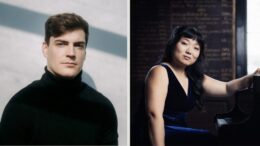
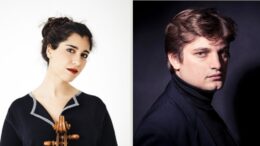
Foyle-Štšura Duo (violin and piano)

Opening the concert is the only full work Mozart ever wrote in E minor. Written upon hearing the news of his mother’s death, the tragic nature is transformed in a section in the second movement that Albert Einstein described as ‘a vision of paradise’.

Faure’s Berceuse is a true gem from early in his career and, due to its immediate success, helped him to find his first publisher. A typically epic (yet rarely heard) work of Busoni concludes the concert. The practice of arranging and transcribing other composers’ music was an integral part of his creative process, and this Sonata constructs variations on a theme of Bach’s choral ‘Wie wohl ist mir’. Busoni viewed this magnificent composition as his ‘true opus one’.


Felix Gygli (baritone) and Jong Sun Woo (piano)

Join us for a recital of German Lieder, tracing the fragile thread of the human experience of love, loss, and longing.

Schumann’s Tragödie and Five Lieder Op. 40 songs reveal intimate dramas—fleeting tenderness, dreamlike innocence, and the stark shadows of betrayal and fate. Korngold’s 6 Einfache Lieder then open a palette of cinematic warmth, where whispered letters, wandering nights, and quiet heroism unfold. Finally, Zemlinsky’s Op. 8 songs rise with striking intensity—vigils, lamentations, and the stern song of the watchtower.

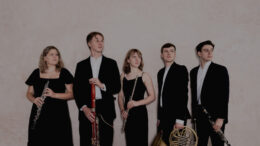
Ensemble Renard (wind instruments)

Escape from the clamour of the city and join Ensemble Renard for a recital of music that captures the symbiotic nature of humanity’s relationship to the natural world.

Wolfgang Amadeus Mozart, famed for writing the most touching and human of music, frequently wrote pieces for automated instruments such as his Andante K.616, to which we give a new life in an arrangement for wind quintet.

Blue Cheese and Olive Oil by Cheryl Frances-Hoad takes inspiration from foods associated with two pillars of 20th-century European musical culture, and George Stevenson’s Les Machines de l’île is a musical description of the wooden creatures that decorate the old dockyard in Nantes, France.

Interspersed between these musical manufacturings, Ensemble Renard present three works that capture the humanity of different folk traditions: Judith Weir’s Mountain Airs is a free adaptation of two Scottish folk tunes; Pavel Haas’s Wind Quintet takes inspiration both from Moravian folk music and Jewish liturgical practice; lastly, Béla Bartók’s Six Dances in Bulgarian Rhythm pulse with celebratory rhythmic vitality.


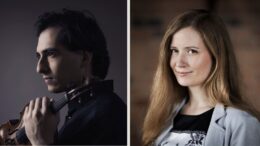
Basil Alter (violin) and Aleksandra Myslek (piano)

Stravinsky’s violin transcription of his neoclassical success Pulcinella pairs well with Beethoven’s first violin and piano sonata from the Op. 12 set. Both composers were influenced by imagining the past in their present-day – Beethoven emulating one of his favourite composers, Mozart and Stravinsky restyling the music of the Italian baroque. Tchaikovsky’s Valse-Scherzo completes this programme of violin recital favourites.


Ariana Kashefi (cello) and Petr Limonov (piano)

City Music Foundation Alumna, Artist Ariana Kashefi returns alongside her long-standing duo partner, Petr Limonov, for a captivating programme featuring works from their debut album, recorded for the Champs Hill label. The centrepiece of the programme is Beethoven’s third Cello Sonata, a true masterpiece of the cello repertoire.

Antoine Préat (piano): Fortune’s Fool

Celebrating the release of his new Album “Fortune’s Fool” , pianist Antoine Préat shares a programme of Haydn, Chopin, and Prokofiev, marrying wit, lyricism and tragedy.

This lunchtime concert will include Haydn’s scintillating Fantasia, Chopin’s Three waltzes op. 34 and Prokofiev’s Romeo and Juliet, telling tales of youth, love, hope and despair.


Anhad Arora (harpsichord)

This programme explores the vibrant world of early German keyboard music that shaped J. S. Bach’s own style and imagination.

It opens with the exuberant invention of his G major Toccata from where the lineage of this energy is traced through pieces by Bach’s North German predecessors and contemporaries. The programme culminates in Bach’s Toccata in D, with all the drama and structural mastery of Bach’s incredible output for keyboard.


Aleksandra Myslek (piano)

Polish pianist Aleksandra Myslek traces her rich and varied musical career with a recital that evokes her influences and experiences.

From the much-loved Chopin’s Heroic Polonaise to honoring her late teacher, Hamish Milne, with glimmering works by Medtner, she also nods to her best friend, fortepianist Emil Duncumb, with rarely heard, charming Mozart variations ‘Salve tu, Domine’. Some of the most inspired Liszt transcriptions of songs and operatic repertoire serve as an invitation into her love of voice, and Chopin’s own favourite work, the deeply romantic Ballade No. 1, will serve as a final acknowledgment of her Chopin-filled early education.

Apollo’s Fire: Pubs and Palaces of 1610

Six musicians from Apollo’s Fire invite you back to the year 1610 in this lunchtime chamber recital. This fascinating programme explores the rich musical world of 17th-century Europe, where music flowed freely from taverns to courtly halls.

Art music and popular music walked hand in hand in those days, as many composers wrote artful variations on popular songs. The sounds of plucked instruments – lute, oud, and harps – accompany voices and violin in this musical voyage from the British Isles to the Mediterranean. Performing in the historical troubadour tradition, harpist/soprano Anna O’Connell accompanies herself in John Dowland’s soulful lament, Flow My Tears. Soprano Lucine Musaelian accompanies herself on the viola da gamba as she sings a haunting Armenian love song. Oud master Ronnie Malley sets sparks flying as we finish the program with a brilliant Turkish dance.

Part of Apollo’s Fire Residency at St Martin-in-the-Fields. Be sure to catch the full baroque orchestra in their Friday evening programme (“FENCING MATCH”) and their Saturday evening concert (“O JERUSALEM!”).


Hugo Williamson (tenor) and Daniel Blaze (piano)

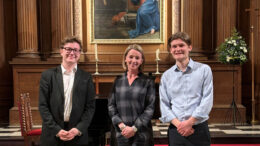
Founded in 2010, the biennial Clare College, Cambridge Song Competition celebrates the best solo singing and piano duos at Cambridge University. Many of the former winners have gone on to become Young Artists at both Glyndebourne and the Royal Opera and are now working internationally as successful professional singers and musicians. The young winning duo of this year’s competition, Hugo Williamson and Daniel Blaze, (with Sarah Tynan on the jury) gave a recital celebrating song repertoire – one of the aims of the competition.

Hugo Williamson is in his final year studying music at Robinson College Cambridge, holding a choral scholarship with Gonville and Caius choir while being a current member of Genesis Sixteen. He has studied for two years within the Sir Arthur Bliss Lieder Scheme and has been a member of the University Chamber Choir. Recent recital highlights include Vaughan Williams’ On Wenlock Edge, Finzi’s A Young Man’s Exhortation alongside operatic roles such as The Madwoman in Britten’s Curlew River, Orpheus in Offenbach’s Orpheus in the Underworld and Prologue/Peter Quint in Britten’s The Turn of the Screw. Next year Hugo is excited to be joining the Voces8 Scholars programme.

Daniel Blaze is a third-year music student and Senior Organ Scholar at Clare. As Organ Scholar, he has played for two broadcast services and has accompanied the choir in venues in the Netherlands, the United States, and various locations in England. In addition to his organ scholarship, Daniel is an accomplished pianist, having accompanied many of the finest singers and instrumentalists in recitals around Cambridge, and winning a place on the prestigious University Lieder Scheme. An experienced singer, Daniel founded, directs, and sings with Lady Clare’s Consort, a Cambridge based ensemble specialising in renaissance music, as well as performing with the Cambridge University Chamber Choir and Clare College Chapel Choir – when he is not playing the organ!