Apollo’s Fire: O Jerusalem! Crossroads of Three Faiths

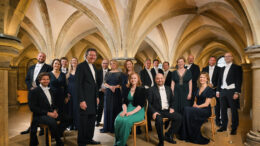
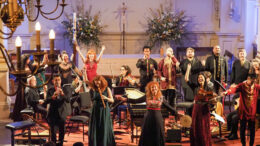
Honouring the peoples whose music and faith brought such vibrancy to the Middle East, this acclaimed programme from Jeannette Sorrell is a musical tour of the four quarters of Old Jerusalem (Jewish, Christian, Muslim, and Armenian).

Surprising cross-influences emerge, as a Sephardic ballad leads to a classical Arabic love song, and selections from Monteverdi’s Vespers of 1610 echo the exotic and rapturous singing of the Jewish cantors in the temples. Twenty-six artists from Jewish, Palestinian, and Christian backgrounds perform on oud, theorbo, medieval harp, zither, strings, and percussion in a joyous celebration of shared humanity.

“Brims with energy and imagination… Programmed with real vision and beautifully performed, a mesmerising portrait of Old Jerusalem reimagined through sound.” (BBC Music Magazine).
 

Apollo’s Fire: Fencing Match – Duelling Double Concertos

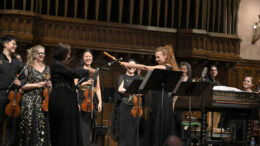
The Americans and Brits face off in a lively transatlantic ‘duel’ (no muskets or bayonets this time):

Apollo’s Fire (‘the USA’s hottest baroque band’) is joined by principal members of the English Baroque Soloists for a spirited evening that includes the Bach Double Violin Concerto, music by Vivaldi and a colourful suite by Marais.

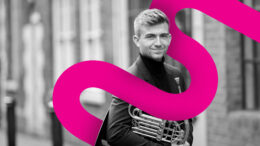
Siren Songs and Serenades: LMP with Ben Goldscheider

Music is born from the world around us – shaped by the people we meet and the stories that stir our imaginations.

Commissioned by the legendary horn player Dennis Brain, Britten’s Serenade wasn’t just written for his performer – it was written with him. Britten and Brain’s personalities both shine through, showing off how the creative dialogue has been woven in, making it as much of a reflection of the performer as the composer himself.

The spirit of collaboration continues in the world premiere of Sirens by GRAMMY-nominated composer Anna Clyne. Dedicated to tonight’s horn soloist Ben Goldscheider, the music draws on the myth of the sirens who lured sailors to their doom with their irresistible voices. Working closely together, Anna and Ben pushed the boundaries of the horn to conjure the sirens’ hypotonic sound world; ethereal, beguiling and completely entrancing.

Adding to the drama of this concert is Mendelssohn’s fiery Symphony No.1, written early in the composer’s life and packed to the brim with energy.

Four Seasons across the World: Vivaldi and Piazzolla

Vivaldi’s Four Seasons is a classical music favourite, vividly capturing nature’s drama from the freshness of spring to the crackle of a summer storm. But how would these seasons sound for a climate on the other side of the world?

Enter Astor Piazzolla – the revolutionary Argentinian composer who transformed the tango with his blend of classical and jazz influences. His Four Seasons of Buenos Aires, written 200 years after Vivaldi’s original, reflects the city’s urban charm, with sweeping melodies and vibrant bursts of those recognisable tango dance rhythms.

Piazzolla nods to Vivaldi in his piece, but not exactly where you might expect. Living on different continents, the two composers experienced the seasons in contrast – you might hear some piercing echoes of a Venetian winter seep into the sultry heat of a Buenos Aires summer.

To heighten your listening experience, specially commissioned, bespoke visuals will spill across the walls of St Martin’s, transporting you across the hemispheres as you’re immersed in the seasonal changes.

LMP: Haydn and Mozart

By the time they had mastered their craft, both Mozart and Haydn were ready to have a bit of fun.

Take Haydn’s Symphony No.89, affectionately nicknamed ‘The Hen’. Though the title wasn’t his own, it’s easy to hear why it stuck. The clucking violins and oboes evoke a whole farmyard of strutting and bobbing poultry. It’s a light-hearted moment from the man often called ‘The Father of the Symphony’.

Mozart, too, had a mischievous streak. Credited with shaping the piano concerto as we know it today, Mozart had the confidence to defy expectations in his music, like in his Piano Concerto No.23 where the final movement playfully pits piano and orchestra in a cheeky musical chase.

Also in this concert is music from Haydn and Mozart’s contemporaries; Marianna Martines – the first woman to write a symphony – and Boulogne.


Tenebrae and Britten Sinfonia: Seven Last Words

Barber’s Adagio and Allegri’s Miserere prepare the way for James MacMillan’s great Passion meditation, in this emotionally-charged evening from Nigel Short and Tenebrae.

For Sir James MacMillan, “beauty is at the heart of our Christian faith”, and few living composers communicate with such emotional directness – taking ancient texts and charging them with a wholly original intensity, wonder and imaginative fire. Composed in 1994, his Seven Last Words have already become a classic. Now, on the eve of Holy Week, they form a passionate climax to an superbly-imagined sequence of musical meditations from Nigel Short, the Britten Sinfonia and Tenebrae  – the virtuoso British chamber choir whose singing was described by one critic as “a kind of musical miracle”.

The Gesualdo Six: Pärt Passio

Arvo Pärt once asked a streetcleaner what a contemporary composer should do. The answer? “He should love every note”. The result was Passio – a retelling of Christ’s Passion in which every note matters, every emotion is sincere, and even the darkest sorrow has an inner light. Heartfelt, luminous and serene, Passio is a masterpiece for our time and for all time, and when the Gesualdo Six and St Martin’s own choirs performed it here in 2022 it made a deep impression – “ecstatic”, in the words of one critic. Spiritual refreshment, from the deep, quiet soul of one of a legend among living composers.

The Sixteen: Mother of Mercy – Music for Lent

Lent is supposed to be a time of reflection and austerity, but everything’s relative, and in Portugal, in the 17th and 18th centuries, those weeks of fasting were the pretext for a feast of sacred music at its most emotionally charged. Harry Christophers and his world-famous chamber choir The Sixteen invite us to the banquet today, and music as glorious as Lotti’s Crucifixus needs no introduction. But that’s just for starters. Savour yearning melodies, lush harmonies and soaring, impassioned prayers from Melgas, Caldara and Rebelo, as well as the blossoming, endlessly expressive imagination of Domenico Scarlatti. Self-denial has never sounded so indulgent…

The Gesualdo Six/Bill Barclay: Death of Gesualdo

Performed by The Gesualdo Six (director Owain Park) with six dancers

Created and directed by Bill Barclay
Choreography by Will Tuckett
Puppet design by Janni Younge
Costumes by Arthur Oliver
Produced by Concert Theatre Works

In this theatrical concert, the Gesualdo Six reunite with director Bill Barclay to create a follow-up to their international hit Secret Byrd, and open St Martin’s 300th anniversary year.

Six singers, six actors and a puppet enact a series of narrative tableaux which open on the composer’s deathbed and superimpose iconic moments from his life onto some of his most chilling music. The result, a Stations of the Cross for the composer’s tortured conscience, will be the boldest look yet at how the life and music of this enigmatic prodigy must function together for the true Gesualdo to emerge from the shadows.

The madrigalist Carlo Gesualdo (1566-1613) may be most famous for murdering his wife and her lover in bed, but among composers he is revered for anticipating chromaticism by 200 years. Gesualdo’s tortured mind led him into a life of violence and suffering, concluding in appalling tales of sorcery and flagellation. However shockingly macabre his biography, the Prince of Venosa’s malignant narcissism can be traced to key incidents from his upbringing in the zero-sum game of Catholic politics.

Commissioned by The Church of St Martin-in-the-Fields, The National Centre for Early Music in York, and Music Before 1800 in NYC.

This concert lasts one hour with no interval.

For more information about your visit, please see our FAQ page.


La Nuova Musica: Mozart C Minor Mass

Mozart’s mighty C minor Mass – the climax of an evening of 18th century vocal music at its most powerful from La Nuova Musica and Schola Cantorum Oxford.

No-one truly knows why Mozart wrote his towering Mass in C minor, or why he left it unfinished. Some say that it was composed in fulfilment of a vow; others maintain that it’s even greater than his Requiem. But everyone who hears it agrees that it’s one of the mightiest and most affecting of choral masterpieces, and for David Bates and La Nuova Musica, it deserves to be treated like the jewel it is. Two outstanding solo singers join the choral forces of Schola Cantorum Oxford to give it a truly magnificent setting, including rarely-heard rediscoveries by Mozart’s friend Haydn, and his inspiration, Handel.